Despite being regarded as the "King of Rock & Roll", Elvis only ever won a Grammy for his gospel music.
Elvis was a friend of
Johnny Cash and the two of them would imitate each other.
The FBI had over 600 pages of files on Elvis. The FBI wanted to know about death threats and other important things about him.
Elvis was mentioned in
Shania Twain's song "That Don't Impress Me Much", taken from her 1997 album
Come On Over, in
Marillion's song "Three Minute Boy", taken from their 1998 album
Radiation and in
Roy Orbison's song, dedicated to Elvis, entitled "Hound Dog Man".
Elvis is a distant cousin of
President Jimmy Carter. He is also a direct descendant of Abraham Lincoln's great-great grandfather, Isaiah Harrison.
Even today, Elvis' legacy of being generous is still alive with his fans keeping up his tradition in his name.
Elvis was nominated for a "Grammy for Best Soundtrack Album or Recording of Original Cast from a Motion Picture or Television" for G.I. Blues and Blue Hawaii in 1961 and 1962 respectfully.
In 1963, Elvis won second place in the "Golden Laurel for Top Male Musical Performance" in Girls! Girls! Girls!. In 1965 he won third place for his movie Viva Las Vegas. In 1966, he finally won the award for his movie Tickle Me.
Elvis dated a number of women before marrying
Priscilla, especially starlets and co-stars of his movies. He briefly dated actress
Natalie Wood early in his career. He dated his
G.I. Blues co-star, actress/dancer
Juliet Prowse. He dated actress
Connie Stevens for a short time. He dated co-star
Anne Helm during the filming of
Follow That Dream. He dated actresses Regina Carrol and
Ann-Margaret for a short time, both of whom he met while filming
Viva Las Vegas. He also once dated actress
Cybill Shepherd. His last relationship was with
Ginger Alden. They were together from November, 1976 until his death and were reportedly engaged to be married.
When
The Beatles first came to America in 1965, Elvis was the only person they wanted to meet. On August 27, they got their wish. According to
John Lennon, they spent an entirely enjoyable evening at the Presley home in Bel Air, California, talking, singing and laughing with each other. Afterwards, Lennon said they enjoyed his company very much. Ironically, Elvis thought the Beatles were a bad influence on America's youth.
Elvis purchased his famous Graceland mansion (along with the now infamous pink Cadillac for his mother) in 1957. In 1982,
Priscillaopened Graceland to the public, claiming the funds were necessary to maintain the property. Today, Graceland is the second most-visited house in America after the White House. Highway 51, which runs in front of Graceland, was officially renamed Elvis Presley Boulevard.
Elvis once wrote a letter to
President Richard Nixon, asking to become an undercover narcotics agent. President Nixon responded by providing Elvis with a special agent badge for the Bureau of Narcotics and Dangerous Drugs.
Elvis' songs Hound Dog, All Shook Up and Heartbreak Hotel are ranked #31, #68 and #71 on VH1's 100 Greatest Songs of Rock & Roll (2002).
Elvis gave people he was close to, matching diamond and gold necklaces sporting a thunderbolt. The masculine necklace was engraved with "TCB" (Taking Care Of Business) and the feminine necklace was engraved "TLC" (Tender Loving Care).
In 1956, Elvis released his first RCA single, had his first television appearance, and his first movie release.
Elvis had a cook named Alvena Roy, who resided in Los Angeles. She was very active in Elvis clubs in the '90s, and used to love to tell stories about him.
Throughout 2006, Elvis Presley Enterprises celebrated the 50th Anniversary of the year Elvis became a superstar, which was the lightning rod for the controversy of early rock 'n' roll.
Elvis is one of only a few artists, including
Johnny Cash and
Hank Williams, to be inducted into both The Rock & Roll Hall Of Fame and The Country Music Hall of Fame.
Elvis once gave a robe to
Muhammad Ali embroidered with the phrase "The Peoples Champion."
On August 29, 1977, there was an attempt to steal Elvis' body, but it failed. Because of that,
Vernon Presley received approval from the Memphis Adjustment Board to allow re-interment of the bodies of Elvis and his mother, Gladys, in the Meditation Garden behind Graceland.
Elvis suffered from chronic insomnia. His doctor prescribed him highly addictive sleeping pills, which some people believe led to his untimely death.
Elvis was diagnosed with glaucoma in the 1970s.
The Holy Bible and The Impersonal Life were Elvis' two favorite books.
Elvis' favorite actors were reported to be
Marlon Brando and
James Dean, whom he credited in a 1956 interview as being acting genius'.
Elvis' favorite sports were raquetball and football.
Elvis was featured on a 5.50 kr postage stamp issued by Sweden in 2004.
Elvis purchased a poor black East Memphis woman an electric wheel chair, picked her up and personally sat her in it (1976). He gave his car to the woman's teenage daughter after she told him she liked his car and he also got her boyfriend a job.
Elvis helped to support an All-Negro Day at the Memphis Zoo in 1956.
By the time he died, Elvis was the second biggest selling recording artist of all time after
Bing Crosby.
Elvis once attended a concert for singer
Connie Francis, but left for emotional reasons when he heard her sing the Italian song "Mama" as his mother had just recently died.
Elvis held a single day's attendance record for his March 74 shows at the Houston Astrodome in March 1974, with 89,000 fans attending two shows.
Elvis was the #1 touring act in America for the year of 1977.
Elvis received 3 Grammy Awards for his Gospel music, two of which were the 1968 and 1975 which was from his rendition titled "How Great Thou Art."
Elvis' debut album Elvis Presley earned him his first gold album award.
Elvis' song "Heartbreak Hotel" (1956) was the No. 1 country song of the year 1956 and it then went Gold.
During the 60s and early 70s Elvis used to play touch football at Whitehaven High School with kids around the neighborhood.
Elvis loved football very much and often had three televisons set up at Graceland to watch all of the games.
Elvis has also been the subject of many documentaries, including the theatrically released hybrid film This Is Elvis (1981), which combined actual Presley footage with reenactments of incidents in his life.
Elvis has been portrayed in a number of films and TV movies, perhaps most notably in
John Carpenter's telefilm,
Elvis (1979), in which he was played by
Kurt Russell, who as a child had appeared with Presley in
It Happened at the World's Fair (1963).
Elvis' 1960 single It's Now Or Never is one of the best selling singles of all times (if not 'the' best selling single) with sales which are estimated between 25 and 30 million copies.
Elvis reportedly fell for
Elizabeth Montgomery on the set of
Kid Galahad (1962). She is said to have visited his house on two occasions. Nothing came of it as she was married to
Gig Young at the time, but they remained good friends until he passed away.
The lightest Elvis ever weighed, as an adult, was 170 lbs in 1960 following his discharge from the U.S. Army. The heaviest was at the time of his death, which was 260 lbs.
Hysteria over Elvis "sightings" after his death were lampooned in the
Mojo Nixonsong "Elvis Is Everywhere" and the
Living Color song "Elvis Is Dead".
Elvis' 1977 country hit, Way Down, was the No. 1 song on Billboard magazine's country singles chart the week of Elvis' death.
Elvis did not like confrontation. He wanted to fire his manager,
Colonel Tom Parker, many times. He would tell his friends "Tell Parker, he's fired." His friends would go tell him, then the "Colonel" would say "Tell Elvis to tell me personally." Elvis never would. To this day, many people believe that Parker took advantage of Elvis' loyalty.
Elvis was one of the first people in the U.S. to own a "Betamax" system VCR.
Elvis was one of the performers featured on a set of stamps of rock and blues legends issued by the U.S. Postal Service in June 1993. Fans had fought for years to get Elvis a stamp, and many were disappointed that they had to vote for either the "Young" Elvis (which eventually won) or the "Jumpsuit" Elvis. He'd touched so many hearts, they'd hoped both would be released.
The book Elvis was reading at the time of his death was The Scientific Search for the Face of Jesus by Frank O. Adams.
In September of 1955, "Country Song Roundup" magazine was the first to feature and article on Elvis, calling him a "folk music fireball."
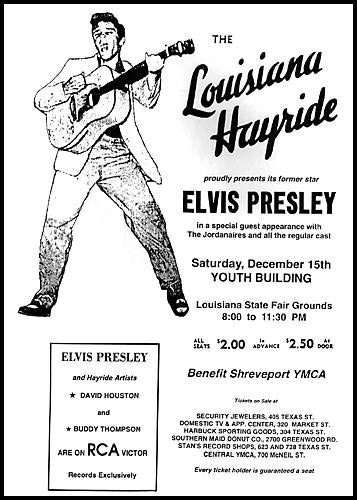
Elvis' television debut was on the regionally telecast Louisiana Hayride, 5 March 1955 in Shreveport, Louisiana.
During July of '77, three former body-guards published Elvis: What Happened? which told about Elvis' drug use for the first time in public.
From June 19-21, '77, concerts were recorded by RCA and were videotaped by CBS for the special Elvis in Concert. The special clearly shows Elvis' deteriorating condition. It wasn't shown until after his death on October 3.
Elvis is touring during the early part of 1977, but from April 1-5, he is hospitalized and some of shows had to be cancelled.
During February, 1976, RCA hauled all manner of mobile recording equipment to Graceland. The week of recording in the den will produce an album From Elvis Presley Boulevard, Memphis, Tennessee A wonderful boost, this album went to #1 on country charts.
On Christmas of '75, Elvis performs a New Year's Eve concert in Pontiac, Michigan, and sets a single performance record of 62,500.
In 1951, Elvis was a member of the the ROTC unit at Humes High.
The Pentecostal church services attended by the Presleys was the first place that exposed the young Elvis to music. It is also where he picked up a lot of his "habits" during his stage performances.
When Elvis was three, his father,
Vernon Presley, served an eight-month prison term for writing bad checks. After his release, the senior Presley's erratic employment kept the family just above the poverty level.
Elvis more or less considered his singing career primarily as a means to an end; his real ambition was to be a movie star.
Despite declining health, Elvis maintained a full schedule of live appearances up until his death at the age of 42.
Actor
Nicolas Cage, who was briefly married to
Lisa Marie Presley, is a noted Elvis fanatic. He is even reported to have a shrine to "The King" in his home.
Even though certain aspects of his later lifestyle would show differently, Elvis was a devoutly spiritually minded Christian.
Besides his late brother Jesse, Elvis had three step brothers by his father's second marriage to Davada Stanley Presley.
In 1969, Elvis appeared in his last fiction film as the star, Change of Habit. It was his 31st movie.
In 1972, Elvis had his last Top 20 hit: "Burning Love." It went to #2 on the charts.
On June 26, 1977 Elvis' last live performance anywhere was in Indianapolis, IN.
In 1979, the Tennessee Board of Medical Examiners charged Presley's private physician Dr. George Nichopoulos with "indiscriminately prescribing 5300 pills and vials for Elvis in the seven months before his death"; Nichopoulos was later acquitted.
For a short time, Elvis left the concert stage and concentrated on film acting; by the mid-1960s he was making $1 million per film plus a large percentage of the gross.
Elvis made his last appearance at the Hilton between December 2-12 of '76.
On August 18, 1975, Presley begins an engagement at the Hilton which is cut short on the 20th as Elvis returns to a hospital in Memphis until September 5.
On January 29 - February 14, 1975, Elvis is hospitalized yet again for drug related medical problems. From here, Elvis' health starts to decline.
In August of 1974, Elvis supposedly received an offer to resurrect his acting career when
Barbra Streisand and her producer-boyfriend
Jon Petersoffered Elvis the lead role in the remake of
A Star is Born. Although Elvis was bored on the road and needed a new challenge, the opportunity never came to fruition.
Priscilla and Elvis get divorced on October 9, 1973. Although Priscilla is granted custody of
Lisa Marie, Elvis remained very close to both of them.
On March 1973, Colonel Parker sells RCA the E's royalty rights on Elvis' entire recording catalog up to that point. 700 songs for five million dollars. A good deal for the Colonel, but a bad deal for Elvis and his heirs who could have enjoyed a lifetime income off those songs.
On January 14, 1973, Elvis: Aloha from Hawaii was taped at Honolulu International Center Arena. It was seen by nearly 1.5 billion people. The album went to #1 quickly, it was al Elvis' last album to do so.
During June 9-11, 1972, entertainment history is made as Elvis, in advance, sells out all four engagements at Madison Square Garden. Among the 80,000 attendees were John Lennon, George Harrison, David Bowie, Bob Dylan and Art Gurfunkel. His stirring rendition of "An American Trilogy" was a highlight. Surprisingly, this was Elvis' first live concert in New York City.
During March and April of 1972, Elvis films on and off stage during his 15-city concert tour. This tour started in New York and ended in New Mexico. The footage is part of the documentary Elvis on Tour, which recoups it's production costs after three days in theatres and receives a Golden Globe Award for Best Documentary.
In June of 1971, More recording in Nashville, mostly for the gospel album He Touched Me, which won Elvis his second Grammy Award.
August 18, 1977, Elvis was buried in Forest Hill Cemetery in Memphis.
January 16, 1971.Elvis accepts the honor of being named One of the Ten Outstanding Young Men of the Nation by the United States Junior Chamber of Commerce (The Jaycees). He is very proud of this - and rightly so.
July 31 - August 28, 1969. The now famous four-week, fifty-seven show engagement at the International Hotel in Las Vegas. His show is wildly successful. Elvis' first live album, Elvis in Person at the International Hotel is recorded during this engagement.
During January and February of 1969 Elvis records some of his best work ever. Returning to Memphis, his produces four hits which will be released in late '69 and early '70. They are "In the Ghetto," "Suspicious Minds," "Don't Cry," "Daddy" and "Kentucky Rain."
June 27, 28, 29, and 30, 1968. Taping for an NBC television special, which actually aired on December 3, 1968. The true name was Elvis but it is commonly called the '68 Comeback Special.
February 1, 1968, nine months to the day of their wedding, Priscilla gives birth to Lisa Marie Presley.
May 29, 1967, Elvis and Priscilla dress in their wedding clothes and have a second wedding reception in the trophy room at Graceland to include their family and friends who were not in Las Vegas for the wedding.
May 1, 1967. Just after 9:30AM Elvis married Priscilla in a small, private ceremony at the Aladdin Hotel in Las Vegas. A press conference and breakfast reception follow. Then the couple honeymooned for a few days in Palm Springs.
With his huge generosity always evident, in July, 1964, Elvis donates $50,000 to the Motion Picture Relief Fund, reportedly the largest single donation the organization has ever received up to this date. Barbara Stanwyck and Frank Sinatra accepted the gift.
In early 1964 Elvis purchases the Potomac, former presidential yacht of Franklin Roosevelt, for $55,000.
Elvis records and shoots for his fifteenth motion picture, Kissin' Cousins in October of 1963.
In July, '63, Elvis had gone to Las Vegas to film one of his most popular films: Viva Las Vegas.
Priscilla Beaulieu flew from West Germany to visit Elvis for Christmas 1962. In early 1963 she moved to be with him, and finished her senior year of high school in Memphis.
March 25, 1961 fouds Elvis at the Bloch Arena at Pearl Harbor. His performance and support raised money and awareness which enabled the USS Arizona Memorial to be completed the following year. This was Elvis' last live, non-movie performance until his 1968 television special.
On July 3, 1960, Vernon Presley married divorcee and mother of three sons, Davada (Dee) Stanley, an American whom he met in Germany. Although they lived at Graceland briefly, they later moved to a home nearby.
May 8, 1960 brings ABC airing Frank Sinatra's Welcome Home, Elvis edition of his variety show, for which Elvis was paid a staggering $125,000.
Having developed an interest in karate while in the Army, Elvis received his first degree black belt in March of 1960.
Elvis returned from Germany on March 2nd, 1960, and was officially discharged from military service on March 5.
In early 1960, Elvis was promoted to Sergeant in the Army.
Elvis first meets Priscilla Beaulieu in November of 1959. She is the only child of a Navy pilot, Jack Wagner, who was killed in a plane crash when Priscilla was an infant. Her mother Ann had remarried to Captain Joesph Beaulieu.
Elvis' mother, Gladys Presley, died on August 14, 1958, due to acute hepatitis. Elvis was able to get back and see her before she died.
In March, 1958, Elvis was inducted into the U.S. Army at the Memphis Draft Board and is assigned serial number 53310761. Pvt. Presley goes to Fort Hood, Texas for basic training and is stationed there for six months.
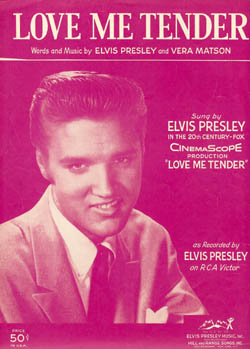
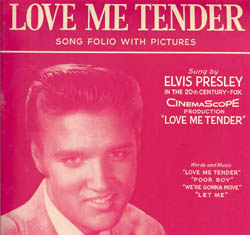
Elvis' first movie, Love Me Tender, premiered on November 16, 1956.
In July of 1956 he does a parody of that sketch on Steve Allen's show by singing to a real Bassett hound. Elvis wasn't happy about the idea - but he does it anyway. His success on Berle and Allen prompt the previously reluctant Ed Sullivan to sign a three appearance deal for $50,000 - an unheard of amount back then.
In April of 1956, Presley signed a seven-year movie contract with Hal Wallis and Paramount Pictures. Through-out his movie career, he longed to do a serious movie, but he was only offered "silly" roles for the most part. It seems the greediness of his manager Col. Tom Parker was to blame; he wanted Elvis to star in as many pictures as possible, and to film them as quickly as possible, in order to get as much money as they could.
Between January 28 and March 24 of 1956 Elvis made 6 appearances on the Jackie Gleason-produced Stage Show, starring Tommy and Jimmy Dorsey on CBS.
When Elvis' now legendary hit Heartbreak Hotel was released, it sold 300,000 copies the first week.
In August of 1955, Colonel Tom Parker replaces Bob Neal as Elvis' manager.
In the Summer of '53, Elvis drops into the The Memphis Recording Service (Sun Studios) and records "My Happiness," and "That's When Your Heartaches Begin." The cost for the recording was $4.00.
Elvis' favorite female singer was Anne Murray and he recorded a version of "Snowbird."
Elvis' parents made cameos in his film, Loving You.
Elvis was offered the lead role of Tony in the film adaptation of the Broadway musical,West Side Story, but Colonel Parker forced to make Presley turn it down as non-commercial despite Elvis' arguments it would legitimize his acting career. The film won ten Academy Awards including Best Picture. A very unfortunate choice...
Elvis was proud of his role in King Creole because the part was originally offered to one of his idols, James Dean. Although songs were later slipped into the movie, Elvis considered it his best work.
Billboard's Joel Whitburn declared Elvis the "#1 Act of the Rock Era," beating out The Beatles. His opinion was based upon Elvis' dominance of the top 100 list of singles artists since 1955.
Elvis Stojko, a Canadian who was the three-time World Figure Skating Champion, was named after Presley by his mother, who was a big fan.
According to Steve Brown's book, Scandalous Freedom: The Radical Nature of the Gospel, Elvis gave a concert and, at its conclusion, a woman came forward with a crown restling on a plush pillow. She lifted the crown to Elvis and shouted, "You're the King!" "No, honey," he said, "I'm not the King. Christ is the King. I'm just a singer."
Elvis was the first artist to sell over one billion records worldwide and was the best-selling record artist in history.
Elvis's hair was a natural sandy brown but he dyed it jet black after filming Love Me Tender.
The Cryolophosaurus is nicknamed 'Elvisaurus' because of its head crest being alike to Elvis's hairstyle.
Elvis was drafted into the United States Army for a two year service on December 20, 1957.
Elvis was nicknamed "E" by his bandmates and some of his family members.
Elvis gave money to many charities. Each year giving approximately $1,000 or more to each Memphis-area charity, though he preferred to keep most of his donations anonymous.
On his eleventh birthday, Elvis received a guitar as a gift. He was disappointed because he'd been hoping to get a bicycle.
The only time Elvis ever played outside of the United States was for three concerts in Canada.
Elvis' middle name was spelled 'Aron' on his birth certificate rather than the traditional spelling 'Aaron' to match his twin brother's name, Jesse Garon. It is spelled 'Aaron' on his tombstone.
More of Elvis' favorite foods included pork chops, meat loaf and steak. He liked his meat well-done. Elvis also liked fresh vegetables and creamed potatoes. Along with those, he also liked cheeseburgers and milkshakes, as well as fried peanut-butter and banana sandwhiches.
The exact time and place of Elvis' birth was in a small, two-room house in Tupelo, Mississippi at 4:35 AM on January 8, 1935.
When he died, Elvis' estate was valued at more than $10 million, unfortunately, his estate went through probate, and taxes and fees consumed a stunning 73% of the estate's value, leaving his heirs with less than $3 million.
Elvis had 18 televisions in his Graceland home, including one installed on the ceiling over his bed.
Elvis' idol was General Douglas MacArthur.
Elvis collected statues of Joan of Arc and Venus de Milo.
In 1988, Elvis' name made approximately $15,000,000.
In 2002, a remixed version of his 1968 song "A Little Less Conversation" was featured in a Nike commercial. It was released as a single in the UK, and went straight to #1.
Elvis only made one commercial during his entire career. It debuted on November 6, 1954, and it was for "Southern Made Doughnuts." He sang the jingle "You can get 'em piping hot after four PM, you can get 'em piping hot. Southern Made Doughnuts hit the spot, you can get 'em piping hot after four PM."
In 1985, Elvis was nominated for an ACE for Performance in a Music Special
for: Elvis: One Night with You (1984).
Phillips began working with Elvis in early-1954 and put him in touch with
Scotty Moore (Electric Guitar) and
Bill Black (Acoustic Bass) to work on developing a repertoire and style of his own. On July 6, 1954, the trio was in the studio recording tunes for their first record when Elvis began banging out a raucous, impromptu rendition of Arthur "Big Boy" Crudup's "That's All Right (Mama)". Sam told the boys to "Run through it again and I'll put it on tape" and history was made. Phillips had found his "white man who had the negro feel" and rock and roll sprang forth from its roots in a frenetic blaze of youthful glory.
Ostensibly, Elvis recorded his first acetate as a gift for his mother, Gladys; however, it is more likely that he wanted to bring himself to the attention of
Sam Phillips - as he ignored the cheaper amateur record-making service at a nearby general store. In January of 1954 he returned to Memphis/Sun to record a second acetate : "I'll Never Stand In Your Way" and "It Wouldn't Be the Same Without You". This time, Phillips himself took Elvis's $4.
On a Saturday afternoon in the summer of 1953, Elvis walked into the offices of The Memphis Recording Service (Sun Records) and paid receptionist Marion Keisker $4 to record an acetate disc of "My Happiness" and "That's When Your Heartaches Begin". Although frustrated when he wouldn't categorize himself or say who he sounded like ("I don't sound like nobody"), Marion was impressed enough to take down Elvis's contact information and save some of his recording on tape - noting : "Good ballad singer. Hold."
Elvis' time on Beale Street and the influence of musicians he admired began to overcome his native shyness. He began wearing flashy clothes and letting his hair grow. Although he was a member of his school's ROTC unit, the football coach cut him when he tried out for the team - apparently because he wouldn't trim his ducktail and sideburns. Then, in April of 1953, he set aside his shyness completely and competed in Humes's annual "Minstrel" show. "I wasn't popular in school ... I failed music - only thing I ever failed. And then they entered me in this talent show ... when I came onstage I heard people kind of rumbling and whispering and so forth, 'cause nobody knew I even sang. It was amazing how popular I became after that."
By 1949, the Presley's were living in a Memphis public housing complex called "The Courts" and Elvis was attending Humes High School. When he wasn't ushering at Loew's State Theater or working at Precision Tool or the school library or MARL Metal Products or driving a truck, he was continuing to learn the guitar and study music - soaking up influences, black and white, and accepting help whenever it was offered. Most of what he learned, he learned via ear - by way of jukeboxes, the radio, record store listening booths and live Beale Street shows.
Elvis' first public performance was in a singing contest at the Mississippi-Alabama Fair and Dairy Show on October 3, 1945. The nervous ten-year-old, standing on a chair to reach the microphone, sang
Red Foley's "Old Shep". Three months later, on his eleventh birthday, Elvis received a guitar which cost $12.95 at the Tupelo Hardware Store. He was disappointed because he'd been hoping to get a bicycle - or a rifle.
While Elvis' mom, Gladys, struggled to keep the impoverished family afloat, often relying on government assistance or the charity of neighbors; his dad,
Vernon, drifted from one low-paying job to the next. When Elvis was three, his father was found guilty of altering a check and was jailed for eight months, causing the family to lose their home.
Elvis was born in a small, two-room "shotgun shack" in Tupelo, Mississippi at 4:35 AM on January 8, 1935. Jesse Garon Presley, his identical twin brother, was delivered 35 minutes earlier, stillborn - a fact which haunted Elvis until his dying day, causing him to believe that he had two souls within him, and two lives to live in a single lifetime.