lunes, 21 de mayo de 2012

Elvis at the Clinton Presidential Library


Elvis at the Clinton Presidential Library

 
The William J. Clinton Presidential Library in Little Rock has been opened for almost a decade.  It contains 76.8 million pages of paper documents, 1.85 million photographs, and 75,000 artifacts.
William J Clinton Presidential Library
 
Included with all that important stuff are some pieces of Elvis memorabilia Clinton accumulated during his two terms in office.  These items were mostly sent in by Clinton admirers who knew he was a lifetime fan of Elvis.  In a 2002 newspaper article, Skip Rutherford, president of the Clinton Library Foundation, said, "Clinton… amassed a collection of several hundred Elvis items.  We have [items] ranging from a dancing Elvis Telephone to CDs to salt and pepper shakers.  You name it, we've got it."  He also said they had the famous Elvis swinging legs clock.
Elvis Phone / Elvis Clock Display
 
The Elvis factor at the Clinton Library took a big jump in the summer of 2011 when two new exhibits were presented.  The first was the "Elvis at 21," the outstanding display of iconic photos of Elvis taken in 1956 by Al Wertheimer.
At the same time, the Clinton Library featured "Elvis," a large exhibit of Elvis memorabilia, much of it on loan from Graceland.
Entrance with Huge Banner Announcing the "Elvis" Exhibit
Bill Clinton in Front of Elvis Memorabilia
 
Of course, no Elvis exhibit is complete without a jumpsuit or two, but the Clinton Library had at least three.
Cape from American Eagle Jumpsuit
Check out Photo of Jimmy and Roslyn Carter with Elvis next to Jumpsuit on Right
 
Bill Clinton must have wanted to note the Elvis connection with other presidents.  In addition to Jimmy Carter, the display also featured the famous Elvis and Nixon photo.
Below Photo is the Special DEA Badge Elvis got from Nixon
 
 
One of the more fun items on loan from Graceland is the red MG convertible Elvis drove in the movie Blue Hawaii.
 
Other movie items on display included lobby posters from Love Me Tender and Viva Las Vegas.
Viva Las Vegas was also represented by a red shirt from the movie and one of the original scripts.
 
Artwork of Elvis was abundant at the Clinton Library exhibit.
Painting Depicting both Elvis and Bill Clinton
Artist Peter Mars in front of his Elvis Silkscreens
 
A large plaque explains Bill Clinton's love for Elvis.
 
In a bit of pay-back, one of the new 2012 exhibits at Graceland will feature a Bill Clinton item.  ICON: The Influence of Elvis Presley opened on March 1, and it contains one of Bill Clinton's saxophones from the Library display.


Elvis, Captain Marvel Jr and the TCB Lightning Bolt


Elvis, Captain Marvel Jr and the TCB Lightning Bolt

Just about every Elvis fan know the story behind the letters TCB on his jewelry.  Of course, it stands for Taking Care of Business, which was kind of a slogan for Elvis.
http://www.elvisblog.net/2012/03/31/elvis-captain-marvel-jr-and-the-tcb-lightning-bolt/tcb-ring-and-pendant/
TCB Ring and Pendant
 
However, do you know the origin of the lightning bolt in Elvis' TCB jewelry? 
These lightning bolts are also incorporated into his Karate logo.
http://www.elvisblog.net/2012/03/31/elvis-captain-marvel-jr-and-the-tcb-lightning-bolt/on-karate-patch/
Elvis' Karate patch
 
And on the wall decorations in the basement game room at Graceland.
http://www.elvisblog.net/2012/03/31/elvis-captain-marvel-jr-and-the-tcb-lightning-bolt/the-tv-room-3/
Wall Decorations in Graceland TV Room
 
And on the tail of his Lisa Marie Airplane.
http://www.elvisblog.net/2012/03/31/elvis-captain-marvel-jr-and-the-tcb-lightning-bolt/tcb-on-lisa-marie-4/
Lightning Bolt on Tail of Lisa Marie Airplane
 
I have numerous reference books that say it was inspired by the lightning bolt worn on the chest of Captain Marvel Jr., Elvis' favorite comic book hero. 
http://www.elvisblog.net/2012/03/31/elvis-captain-marvel-jr-and-the-tcb-lightning-bolt/young-captain-marvel-jr/
Young Captain Marvel Jr.

Even more significantly, these sources say that super-hero Captain Marvel Jr. influenced a great deal of Elvis' life and appearance. 
One web site asserts that Elvis read Captain Marvel Jr. Comics from September 1949 to January 1953 while living at the Lauderdale Court.  In fact, the Presley's apartment has been preserved as a historic site, and a copy of Captain Marvel Jr. #51 sits on a desk in Elvis' old room.
http://www.elvisblog.net/2012/03/31/elvis-captain-marvel-jr-and-the-tcb-lightning-bolt/night-stand-at-lauderdale-courts/
Captain Marvel Jr. Comic Book on Elvis' Nightstand
 
In her book "Elvis Presley: The Man, The Life, The Legend," author Pamela Clarke Keough states, "Elvis used comics as an escape… Around the age of 12, Elvis discovered Captain Marvel Jr. and quickly became almost obsessed with him." 
http://www.elvisblog.net/2012/03/31/elvis-captain-marvel-jr-and-the-tcb-lightning-bolt/patriotic-captain-marvel-jr/
Patriotic Captain Marvel
 
Billy Smith, Elvis' cousin and longtime friend, said that Elvis especially admired the dual image of Captain Marvel Jr. and his alter ego — an everyday guy, poor teenager Freddy Freeman.  But, when he said the magic words, Freddie Freeman turned into super crime-fighter Captain Marvel Jr.
The comic book website Dial B for Blog sums it up nicely:  "This is why Elvis idolized Cap Jr. – because the Freddy Freeman/Captain Marvel Jr. character was a perfect mirror image of the once and future Elvis.  Freddy represented Elvis as he was, and Captain Marvel Jr. represented Elvis as he wished to be."
http://www.elvisblog.net/2012/03/31/elvis-captain-marvel-jr-and-the-tcb-lightning-bolt/captain-marvel-jr-and-freddie-freeman/
Captain Marvel Jr. and Freddie Freeman
 
Pictures of Captain Marvel Jr. in the early fifties do indeed show a hairstyle ultimately affected by Elvis — long, glistening, black, with unruly locks hanging down over his forehead.  Also, there is a distinct similarity between Captain Marvel Jr.'s outfit and the seventies Elvis.  The argument certainly can be made that Elvis copied his one-piece jumpsuit, wide belt, boots, and most of all, the cape from his boyhood hero. 
 
Finally, young Freddy Freeman was often seen wearing white scarves, and we all know how Elvis would go through dozens of them at every concert.
There does not seem to be any connection between Captain Marvel Jr. and Elvis in the use of the Taking Care of Business motto or the letters TCB.  That appears to be a unique personal creation by Elvis.
 
       Philip R Arnold,

domingo, 20 de mayo de 2012

The Dick Clark / Elvis Phone Calls


The Dick Clark / Elvis Phone Calls
 When Dick Clark died a few weeks ago, one fact revealed was that he never had Elvis on American Bandstand.  This actually is not too surprising.  Until August 1957, Bandstand had been just a local show on a Philadelphia TV station.  When ABC picked it up and broadcast it nationally as American Bandstand, Elvis was already in a situation where Col. Parker refused to let Elvis appear on TV.  Parker's reasoning was that the fans should not get free looks at Elvis on television.  If they wanted to see him, they had to go to his concerts or watch his movies.
However, Elvis was soon drafted into the Army.  Once he got shipped off to Germany, Dick Clark used his well documented business savvy and set up phone calls to Elvis.  The audio from these calls were rebroadcast on American Bandstand, and they were a good PR move for both the show and Elvis.  Here are the transcripts, with a few minor sentences deleted.
Phone Call # 1 — from Dick Clark to Elvis in Germany – February 1959
Clark: Hello, Elvis.
Elvis: Hello, Dick, How are you?
Clark: Fine, thank you.  Where on earth are you at this minute?
Elvis: The town I'm in is Freidberg, Germany; however, I live in a place called Bad Nauheim, just north of Freidberg.
Clark: Tell me a little bit about your activities.  What did you do, say, today?
Elvis: Mostly classroom work.
Clark: What are you studying?
Elvis: Map reading and then how to grease my Jeep.  Just the regular things.
Clark; Do you have time for music anymore?
Elvis: Only at night.  You see, I get off work at five o'clock in the afternoon, and I have a guitar up here in the room… I don't want to get out of practice, if I can help it.
Clark: I should hope not.  Let me tell you some good news.  In the annual American Bandstand Popularity Poll you walked away with a couple of honors this year.  The Favorite Male Vocalist Award and the Favorite Record of 1958 Award.  The kids voted you top man all around.
Elvis: Well that's sure tremendous, Dick.  It's really great, boy.
Clark: Do you have any idea when you'll be travelling back home?
Elvis: No, I don't, Dick.  I wish I really did know.
Clark: How about it, do you miss home?
Elvis: Oh, boy, I can't hardly talk… I mean, I'm glad that I could come in the Army and do my part, but you'll never know how happy I'll be, boy, when I can return to the entertainment world, because once you get a taste of show business, there's nothing like it.
Clark: You know it.  Elvis, thank you ever so much for talking to us.  We look forward to your return.
Elvis: Well thank you very much.  I'd just like to tell all those wonderful kids that they'll never know how happy they made me, and I'm longing for the time I can come back out and entertain them again, travel around and make movies, records, and things like that.
Phone Call # 2 — from Elvis in Germany to Dick Clark – August 1959 (2nd Anniversary of American Bandstand)
 
One of Dick Clark's questions below makes it sound like Elvis called him, but that seems improbable.  Surely, Elvis didn't just happen to call on the 2nd anniversary of American Bandstand, so Clark's staff probably set it up.  Plus, why would Elvis' gold record for "A Big Hunk of Love" be in Clark's hands before Col. Parker's?
Clark: Hello, Elvis.
Elvis: Hello Dick, how are you.
Clark: I would imagine they've got you kind of busy these days, don't they?
Elvis: Oh yeah, well we're getting' ready for a big inspection.  A new inspection, so we've been workin' pretty hard for that.
Clark: Elvis, so many of us here are interested in your activities and I think probably the big question on most people's minds these days are when and if everything goes right, you're out in February, what will be your plans?
Elvis: Well, as you know, I have a contract with ABC… for some television.  I don't know what Colonel Parker has arranged… And then I have the three pictures to make; one for Mr (Hal) Wallis, and then the other two for Twentieth Century-Fox
Clark: Elvis, I've got some good news.  I imagine by now they've passed the word along to you.  With the latest RCA Victor recording out, "A Big Hunk of Love" and "My Wish Came True," you got yourself another Gold Record to add to the collection.
Elvis: That's great, Dick.  That sure is nice.  I was surprised to hear it, really.
Clark: I'll tell you what.  We're gonna show it to the folks here on American Bandstand, and then I'll forward it down to Colonel Parker, and he can save it for you when you come back.
Elvis: Okay, that'll be fine.
Clark: Elvis, do you have any idea of how many Gold Records you have now in your collection?
Elvis: To my knowledge, Dick…this one will make thirty-one, I think.
Clark; Boy, that is a fantastic record.  There's no getting away from it.
Elvis: I'll ask my daddy to go down and (laughs) and count them.
Clark: Elvis, one more quick question that might interest the gals in this country.  I know probably you don't have much time to yourself but when you go out amongst the German people, what is the thing that strikes you as most interesting?  Are they very different than the people back home?
Elvis: The main difference is naturally the language barrier.  It's kinda hard to talk to most of 'em, especially older ones because a lot of 'em don't speak English at all and I don't speak any German.
Clark: How do you find the reaction of young people toward you, mainly the girls,,, [Do] they go crazy for you?  Do you get along well with them?
Elvis: Yeah, I get along real well. Every day when I finish work and come in, well there's always a crowd at the gate from all over Germany… And they bring their families.  Especially on weekends, I have a lot of visitors here from all over Germany, all over Europe in fact.  They come here and bring pictures and take pictures and everything.
Clark: You're kind of a man torn between two careers, both of which are very, very important.  Elvis, I did want to thank you very much for calling this day.  As you probably know, this is our special anniversary day.
Elvis: Oh, well, congratulations.
Clark: And many, many thanks and we all look forward to your return.
Elvis: Thank you very much… Bye-bye, Dick
Call # 3 – From Dick Clark to Elvis in Germany, January 8, 1960 (Elvis' 25th birthday)
 
As the year 1960 began, there was much speculation in the press that Elvis would soon return to the United States.  Dick Clark certainly realized that if he wanted one more phone conversation with Elvis, he'd better hurry up.  What better time than on Elvis' birthday?
Clark: Hello, Elvis.
Elvis: Hello.
Clark: Hi.  We had no idea we could catch a-hold of you today.
Elvis: Oh, yeah, well I just came in the door, Dick.
Clark: What were you doing?
Elvis: Well, I just came in from the day's work.  It's about five-thirty here.
Clark: You know, Elvis, I called Colonel Tom and had words with his assistant and say, gee, do you suppose there's any chance we could talk to Elvis on his birthday, and they seemed to think you ought to be off on maneuvers.  Have you been pretty busy?
Elvis: Yeah, we've been pretty busy.  I don't go on maneuvers until the twenty-second.
Clark: Oh, I see.  What is the situation regarding your release from the army?  Do you have any word on it?
Elvis: The only thing definite, Dick, as far as the way it stands now, I leave Germany somewhere between the twentieth of February and the second of March.
Clark: When you come back, I understand you've got a television show with Frank Sinatra and a few movies to make.  How are you gonna squeeze 'em all in?
Elvis: Well (laughs), I'm told Colonel Parker will have everything arranged.  I know the first picture is for Mr. Wallis.  It's called G.I. Blues, I think.  The other two's at Twentieth Century-Fox, and I don't know exactly when the television show will be.  In fact, I don't even know what's gonna happen, really.
Clark: Elvis, what is your general feeling about doing your first television show upon your return with Frank Sinatra?  You two fellows have sort of different musical stylings.  Do you have any thoughts on that?
Elvis: Well, I really do.  I consider it an honor, really, Dick, because this man…he's really proven himself.
Clark: He's somewhat of a legend, I guess.
Elvis: He is, and I admire him very much, and I really am honored.
Clark: Let me ask you about your Christmas and New Year's.  How did you celebrate the holidays?
Elvis: We had a Christmas party here.  I had a lot guys from all over the post.  I had as many of the boys here as possible at my house…try to make 'em feel at home around Christmastime.  Then on New year's night we had another little party.  This one was pretty nice, but it was better last year.
Clark: Elvis, I want to thank you very, very much for taking the time out from your busy schedule, to reassure you once again that we're all awaiting your arrival back home, and on this day to wish you a happy birthday.
Elvis: Thank you very much, Dick, and I'm kinda lookin' forward to it.  Yeah, there's still a lot of stuff in print about my getting out early and all that stuff.
Clark: It's not true, as far as you know, uh?
Elvis: Well it's been in print and I had a lot of people ask me about it.  The only time I heard about it is when I read it.
Clark: Elvis, all the best.  We'll see you on your return.
Elvis: Okay, thanks a lot, Dick, and tell everybody hello from me.
 
Elvis' service in Germany officially ended on March 2, 1960.  He resumed his recording and movie careers, and never did appear on American Bandstand. 
The photos above are stock images, not the actual shots taken during the Elvis/Dick Clark phone interviews for American Bandstand.

sábado, 19 de mayo de 2012

Elvis and Southern Maid Donuts


Elvis and Southern Maid Donuts

Most serious Elvis fans know he did only one advertisement during his career.  It was for one of his favorite food items – donuts.  Elvis recorded a radio jingle for Southern Maid Donuts.
 
Elvis' association with Southern Maid Donuts started when he began regular appearances on the Louisiana Hayride in Shreveport, LA, in October 1954.
Elvis performing at the Louisiana Hayride
 
 
Southern Maid Donuts began in Dallas, Texas in 1937, and the total of company-owned or licensed stores now exceeds 100.  The Southern Maid name came about because the founders wanted a name that encompassed humble southern traditions, memories, and feelings. 
 
 
The Louisiana Hayride was a perfect venue for marketing their product, and Southern Maid Donuts provided large sponsorship on the show's radio broadcasts for several years.  The radio spots featured a strange little jingle that deserves some explanation.
 
 
One of Southern Maid Donuts claims to fame is the sign above their stores with giant red neon letters lighting up the night sky  — HOT, HOT, HOT.  The stores sell donuts, éclairs, bear claws, apple fritters and other goodies all day long, starting at 6AM.  But after 4PM, you can order a box of twelve glazed donuts made especially for you and served to you piping hot.  Southern Maid Donuts have no preservatives.  They are made to be eaten HOT, not saved for later.  If you want hot, light-textured donuts that literally melt in your mouth, these are hard to beat.
 
 
So, it follows that their radio jingle was:
You can get them piping hot after 4PM,
you can get them piping hot,
Southern Maid Donuts hit the spot,
you can get them piping hot after 4PM.
 
A number of Louisiana Hayride performers sang the jingle, including Minnie Pearl, Johnny Cash, and Johnny Horton.  Elvis' version aired on November 6, 1954.
 
To my knowledge, there is no remaining copy of Elvis singing the Southern Maid Donut jingle.  I wonder what that would be worth if it ever did surface.  A caller on George Klein's radio show said that he had obtained the commercial in 2009.  If so, why hasn't it been aired by now?
For some reason, the Johnny Cash version of the jingle was preserved, and it can be heard on the CDs, The Best of the Louisiana Hayride, Volume 4, and Johnny Cash: Hayride Anthology.

viernes, 18 de mayo de 2012

Racing Car - Friday


John Force Racing and Lionel NASCAR Collectables to Honor Elvis With 35th Anniversary Race Cars

May 16, 2012


Legendary Funny Car driver John Force and teammate Robert Hight will honor the legacy of the King of Rock 'n' Roll during the 12th annual NHRA Thunder Valley Nationals at Bristol Dragway on June 15 - 17. In conjunction with Elvis Presley Enterprises, Inc. and Lionel NASCAR Collectables, John Force Racing will once again feature Elvis on their one-of-a-kind 8,000 horsepower Ford Mustang Funny Cars. Each driver will be competing in a specially-designed Elvis 35th Anniversary Ford Mustang Funny Car for this one-time special weekend.

"I love Elvis and I am honored to be racing with him on the hood of my hound dog in Bristol. I always say I saw Elvis at 1,000 feet in Memphis and I really believe that. Elvis was such an amazing performer and an icon. I remember listening to his music growing up and heading to the race track. I still make sure my girls all know his songs," said Force, one of the most recent inductees into the International Motorsports Hall of Fame.

Lionel NASCAR Collectables will offer 1:24 and 1:64 scale die-cast cars of both John Force's Castrol GTX High Mileage/Elvis 35th Ford Mustang Funny Car and Robert Hight's Auto Club/Elvis 35th Ford Mustang Funny Car. Each die-cast is currently available for pre-order at www.nhradiecast.com – home of the officially licensed die-cast of the NHRA.

This will be the first time Hight has driven an Elvis-themed Funny Car. The importance of representing a legendary figure is not lost on the 2009 NHRA Funny Car champion and current Full Throttle points leader.

"Elvis has fans all over the world and to be associated with a person of that stature is amazing. Music has always been an important part of my life and when you think of rock 'n' roll, the first name that pops into your head is Elvis. I won at Bristol last year and it would be amazing to get my Auto Club/Elvis 35th Ford Mustang back into the winner's circle this year," said Hight.

For more information on how to purchase the Lionel NASCAR collectable Elvis race cars, visit www.nhradiecast.com.

jueves, 17 de mayo de 2012

Elvis Rumbled in a Bar … Then Rocked on Stage


Toledo 1956

Elvis Rumbled in a Bar …
Then Rocked on Stage

'Tis news for the teen-aged gentry we have today. 'Tis news which indubitably will cause vociferous demonstrations among the numerous rock and roll addicts who are shrieking standard bearers of the side-burned, guitar whacking Elvis Presley. The boy millionaire from the hills of Tennessee is coming to town. That's what we said. He's to visit Toledo in person.
| Mitch Woodbury Reports, The Toledo Blade, November 5, 1956

 It was just a four-city tour in late November 1956. Elvis would play three Ohio cities and close out his final tour of the year in Louisville. He would open up in Toledo on Thanksgiving Day before moving on to Cleveland. Elvis had played that latter metropolis twice the previous year and had performed in Dayton and Columbus earlier in 1956, but this would be Toledo, Ohio's, first exposure to the Presley whirlwind.
Elvis in Toledo 1956 Elvis had been off the road for over five weeks, but his fame had only increased during his absence from the stage. In the interim, he had made his second appearance on The Ed Sullivan Show and filmed his first movie in Hollywood. In fact, when his show rolled into Toledo on November 21, Elvis founded himself in the rare situation of competing with himself. Love Me Tender, which was released nationally that day, began its run at Toledo's Paramount Theater. The city's teenagers had the opportunity to see Elvis on the big screen in the afternoon and then see him live on stage the same evening.
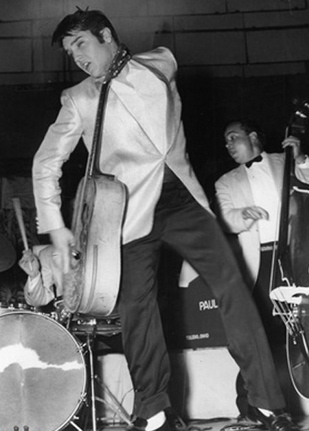
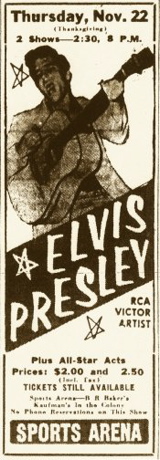
Presley was booked in Toledo's Sports Arena for two shows at 2:30 and 8 p.m. His 30-minute appearance on stage would be preceded by six opening acts, pushing the show's running time to two hours. To get Presley, the 7,500-seat Arena had put up its highest guarantee amount in its history. Arena Manager Andy Mulligan stated that to get Elvis to play this four-city tour, his handlers had to buy him a new Thunderbird. (An obvious example of spurious Colonel Parker propaganda.) The contract also called for sponsors to provide 20 extra policemen for security at each show.
 
• Presley Pummeled Jealous Husband
Local law enforcement, however, came in contact with Presley in Toledo before he ever set foot on the Sports Arena stage. The day before the concerts, Elvis and his entourage arrived in the city and checked into the Commodore Perry Hotel. While sitting in the hotel's Shalimar Room bar with his band mates, Presley was confronted by 19-year-old Louis Balint, who shouted, "My wife carries your picture but doesn't carry mine."
Charles Gilmore reported on the resulting fracas in the Blade: "The free-for-all that followed was broken up by police who found Presley pummeling his accuser who, meanwhile, was endeavoring to toss one of the musicians, Scotty Moore, over a railing that surrounds the Shalimar Room Terrace." The cops hauled off Balint, who was later sentenced to seven days in the Workhouse by a Municipal Court judge. Meanwhile, Elvis received some national press coverage that only increased his image as a rough-and-tumble rebel.

Elvis in Toledo Ad 1956 The next day Presley's show didn't quite sell out the 15,000 seats available for his two appearances. With tickets priced at $2 and $2.50, 13,125 patrons paid a gross of $28,200, of which Elvis left town with $16,000. The gross broke the Arena record of $24,000, formerly held by Bob Hope. Added to Presley's take was an undetermined amount paid for souvenir albums, photographs, popcorn, and binoculars. More showed up to see Elvis in Toledo than had come out to listen to the combined free speeches of Presidential candidate Adlai Stevenson and Vice President Richard Nixon.
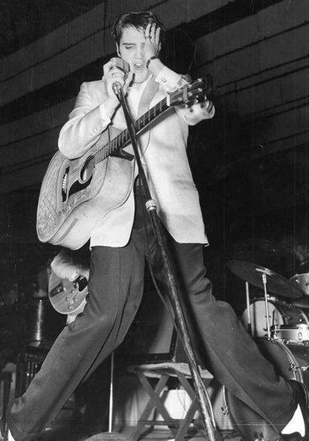
 
• Elvis "stumbled" onto stage
Following the series of acts opening the afternoon show, Elvis finally appeared from the back of the stage. "Presley stumbled forward," noted Gilmore in the Blade, "looked about in an almost bewildered amazement and launched into his first number." Screaming teenagers dominated the audience, but not all of the youngsters in the crowd joined in the uproar, according to Gilmore. "The cut-off point of his popularity was obvious. The scattering of 10 and 11-year-olds in the audience couldn't have cared less. Their reactions ranged from utter indifference to occasional screams, which they could see by looking about, appeared to be the thing to do. They liked the magician on the program better."
Elvis's half-hour of songs was accompanied by what Gilmore termed, "torso twistings described in the burlesque trade as 'bumps and grinds.' The noise rose to a higher pitch each time Presley writhed his torso in rhythm with the beat, or stumbled across the stage in a relaxation that bordered on utter collapse." At one point, foreshadowing his scarf handouts of the '70s, Elvis took off his tie and threw it into the audience. Twelve-year-old Marsha Neill, who caught the tie, later refused an offer of $30 for it.
The screaming in the arena rose to the level of hysteria at times, but the kids were generally well behaved and kept near their seats until Elvis's finale. When he broke into "Hound Dog," his standard closer, according to Gilmore, "it was the signal for the surge to the stage by thousands of youngsters who obediently had kept in their seats throughout the performance. They broke out and jammed down the aisles as an extra crew of 20 policemen watched helplessly."
Elvis in Toledo 1956 By the time they got to the stage, however, Elvis was gone, escaping through the rear of the stage into a car that took him back to his hotel. Arena manager Mulligan gave a girl bus fare home to Detroit after she lost her purse in the scuffle to get at Elvis after the matinee.
 
• Writer claimed fans were coached when to scream
Gilmore drew the ire of some Toledo teenagers for his criticism of Presley in his Blade review the next day. "Elvis Presley boasts he has never had a music lesson, an educational void he clearly demonstrated when he performed," Gilmore declared. The writer also stated that the master of ceremonies coached the crowd on "how to scream, when to scream and where to scream."
Presley's faithful followers fired back in letters to the editor printed in the Blade a week later on November 30. "Elvis has a talent that most teen-agers like," read one letter, signed by four girls. "Most of the parents of today and The Blade critics forget when they were teen-agers. They went batty over such as Frank Sinatra and Betty Gable … You had your turn, now let us have ours."
Billie McAtee wrote to counter Gilmore's claim that the fans were coached. "He was wrong," she declared. "There is one thing that was said, we were told to give him a big welcome and that is what we did. The screaming done after that was because of Elvis, himself, and not because we were coached."
In another letter, Jackie Heinisch disagreed with Gilmore's comments critical of Elvis's singing ability. "Then [Gilmore] went casually on to say he could not hear him. Now if he could not hear him, how could he pass judgment on his singing? Why doesn't he try listening to Elvis' records once, which he obviously never has, and he will be able to see why millions of people buy those records … Maybe he does not concur with me that Elvis is one of the best singers in our country (everyone to his own opinion) but I do not believe Elvis's performance merited the harsh criticism which Mr. Gilmore seemed delighted to give."
 
• Elvis almost waited too long to return to Toledo
If Elvis followed his usual tour pattern, late that Thanksgiving night he and his immediate entourage would have made the short 110-mile drive eastward on the interstate to Cleveland, where he was scheduled to appear the next day. (He may have made the drive the next morning. Since a strike had shut down the Cleveland newspapers at that time, his arrival date in that city is uncertain.)
Meanwhile, Toledo would have to wait a long time for Elvis to return. In 1956 he left the city a vibrant, energetic 21-year-old. When he returned to Toledo on April 23, 1977, he was 42 and in poor health. Elvis Presley died just 16 weeks later.

martes, 15 de mayo de 2012

Elvis in January: Birthdates of Prominent People in Elvis’s World


Elvis in January: Birthdates of Prominent People in Elvis's World
 
January 3 — Marty Lacker, Elvis's right hand man for many years and co-Best Man at Elvis's wedding, was born in 1937.
 
sam phillips.jpg (120830 bytes)
January 5 — Sam Phillips, owner of the Memphis Recording Studio and Sun Records, where Elvis first recorded professionally, was born in 1923. He died in 2003.
 
Elvis in a tuxedo
January 8 — Elvis Presley was born in Tupelo, Mississippi, in 1935. He died in 1977.
 
January 8 — Joan Freeman, Elvis's costar in Roustabout, was born in 1942.
 
January 14 — Clint Reno, Elvis's character in Love Me Tender, was born in 1843. (So read his tombstone in the movie's final scene.)
 
January 19 — Shelly Fabares, Elvis's costar in Girl Happy, Spinout, and Clambake, was born in 1944.
 
Mac Davis
January 21 — Mac Davis, who wrote Memories, In the Ghetto, and Don't Cry Daddy for Elvis, was born in 1941.
 
January 22 — Bill Bixby, Elvis's costar in Clambake and Speedway, was born in 1934. He died in 1993.
 
January 26 — Sid Wayne, who co-wrote 32 songs for Elvis, including "Lover Doll," "Flaming Star," and "I Need Your Love Tonight," was born in 1923. He died in 1991.