| Jerry Leiber along with partner Mike Stoller composed hit songs for many artists, beginning in 1952.
The key Leiber / Stoller compositions that Elvis recorded are "Baby, I Don't Care", "Don't", "Hound Dog", "Jailhouse Rock", "Just Tell Her Jim Said Hello", "King Creole", "Little Egypt", "Love Me", "Loving You", "Santa Claus Is Back in Town", "Saved", "She's Not You", "Treat Me Nice" and "Trouble".
Mike Stoller appeared with Elvis in the 1957 movie Jailhouse Rock, playing piano for Vince Everett's (Elvis') band. This was due to a strange twist of fate since it was actually Jerry Leiber who had been chosen for the part.
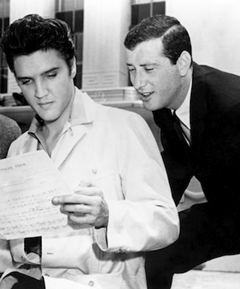
In 2006 Ken Sharp interviewed Jerry Leiber (right with Elvis) and Mike Stoller as part of his impressive FTD book about Elvis' composers, 'Writing For the King,'
Here is an edited version of that in-depth and fascinating interview.
|  |
Jerry Leiber along with partner
Mike Stoller composed hit songs for many artists, beginning in 1952. It is an astounding fact that they composed four classics "Jailhouse Rock," "Treat Me Nice," "I Want to Be Free," and "Baby I Don't Care" in a period of only a few hours one afternoon.
Among classic charting songs they composed for other groups including The Coasters were "Kansas City," "Down in Mexico," "Searchin", "Yakety Yak," "Poison Ivy," "Charlie Brown," "Love Potion #9," "On Broadway," and "Ruby Baby."
The Leiber / Stoller compositions that Elvis recorded are, "(You're So Square) Baby, I Don't Care", "Bossa Nova Baby", "Dirty, Dirty Feeling", "Don't", "Fools Fall in Love", "Girls! Girls! Girls!", "Hot Dog", "Hound Dog", "I Want to Be Free", "If You Don't Come Back", "Jailhouse Rock", "Just Tell Her Jim Said Hello","King Creole", "Little Egypt", "Love Me", "Loving You", "Santa Claus Is Back in Town"
"Saved", "She's Not You", "Steadfast, Loyal, and True", "Three Corn Patches", "Treat Me Nice", "Trouble".
Mike Stoller appeared with Elvis in the 1957 movie Jailhouse Rock, playing piano for Vince Everett's (Elvis') band. This was due to a strange twist of fate since it was actually Jerry Leiber who had been chosen for the part.
Rock'n'roll songwriter Jerry Leiber dead at 78: Jerry Leiber, one of the most important songwriters in the history of rock & roll – whose 60-year partnership with Mike Stoller produced "Hound Dog," "Jailhouse Rock," "Loving You", "On Broadway," "Yakety-Yak", "Stand By Me"and countless other classics – has died of cardiopulmonary failure. He was 78.
His death was confirmed Monday August 22 2011, by his longtime publicist, Bobbi Marcus.
With Leiber as lyricist and Stoller as composer, the team channeled their blues and jazz backgrounds into pop songs performed by such artists as Elvis Presley, Dion and the Belmonts, the Coasters, the Drifters and Ben E. King in a way that would help create a joyous new musical style.
From their breakout hit, blues great
Big Mama Thornton's 1953 rendition of "Hound Dog," until their songwriting took a more serious turn in 1969 with Peggy Lee's recording of "Is That All There Is?" the pair remained one of the most successful teams in pop music history.
Their writing prowess and influence over the recording industry as pioneering independent producers earned them induction into the non-performer category of the Rock and Roll Hall of Fame in 1987.
"The music world lost today one of its greatest poet laureates," said Terry Stewart, president of the Rock and Roll Hall of Fame and Museum.
"Jerry not only wrote the words that everyone was singing, he led the way in how we verbalized our feelings about the societal changes we were living with in post-World War II life. Appropriately, his vehicles of choice were the emerging populist musical genres of rhythm and blues and then rock and roll."Leiber, who like Stoller was white, said his musical inspiration came from the close identification he had with black American culture during his boyhood and teen years in Baltimore and Los Angeles. Thus he was the perfect lyricist for bluesy, jazz-inflected compositions like "Kansas City," ''Black Denim Trousers and Motorcycle Boots," ''Charlie Brown," ''Drip Drop," ''Stand By Me" and "On Broadway."
The result was a serious departure from the classically inflected music that had been produced by a previous generation of pop songwriters that included George Gershwin and Irving Berlin.
Over their career, they had 15 No. 1 hits in a variety of genres by 10 different artists. They were instrumental in helping launch Presley's career with such songs as
"Hound Dog" and
"Jailhouse Rock."In the 1990s their songs became the centerpiece of a long-running Broadway revue, "Smokey Joe's Cafe," which won a Grammy for best musical show album in 1996.
"Jerry Leiber and Mike Stoller have written some of the most spirited and enduring rock 'n' roll songs," the Rock and Roll Hall of Fame said in a statement released at the time of their induction. "As pop auteurs ... Leiber and Stoller advanced rock and roll to new heights of wit and musical sophistication."
Leiber was born in Baltimore in 1933; his parents were Jewish immigrants from Poland. He met Stoller after moving to Los Angeles with his mother in 1950.
Ken Sharp tells of meeting the great composer...
Jerry Leiber was a wonderful songwriter and quite a character. A wordsmith to the end. I recall that he went over my interview that later appeared in "Writing For The King" with meticulous precision and made sure that each word and syllable, each story captured exactly what he intended to convey. I feel deeply honored that i had the opportunity to spend time with him.
God rest his soul....
Elvis author
Ken Sharp (Writing For The King, Elvis: Vegas 69') interviewed the pair in 2006 for his 'Writing For The King' book. This is an edited version of a fascinating and lengthy interview.
Jerry Leiber: The first time I heard Elvis I was up at the Atlantic Records offices with Ahmet Ertegun and Jerry Wexler. They played one of Elvis' Sun Records sides—I think it was
"That's All Right, Mama." Ahmet, puffing on a cigarette, said, "What do you think, man?" And I said, "I think it's pretty good." Ahmet said, "Is that ALL you think, that's it's just PRETTY good?" And I said, "Yeah, I think he's pretty good. He's not the BEST country singer I've ever heard." Wexler said, "Elvis Presley is not considered a country singer. Sam Phillips wants 25 grand for his contract. Do you think he's worth it?" Ahmet said "Yeah, I think so" At that moment Miriam Abramson walked in and said, "Are you kidding? Are you KIDDING? What do MEAN $25,0000?"
Mike Stoller: The first time I received a sizeable royalty check was in 1956. It was for $5,000. I never thought I'd see that much money at one time again. $5,000 was a lot of money in the fifties. Jerry told me "Mike, we have a smash hit!" "You're kidding" I said. And he said, "Hound Dog!". "Big Mama Thornton's record?" I asked. He said, "No, some white kid named Elvis Presley."
Jerry L: I didn't particularly like Elvis' version of "Hound Dog" at the time, but as time passed I grew very fond of it. I'm not sure if it was the actual record itself or the fact that it had become such an anthem.
Mike S: After that, Elvis' music publishers, the Aberbach brothers, contacted us. We had met them a number of times in Los Angeles. They used to have a home and office on Hollywood Boulevard just west of La Brea, They asked if we had any other songs we thought might be good for Elvis. Jerry suggested a favorite old song of ours called "Love Me" that we'd recorded with a gospel group from San Francisco. | 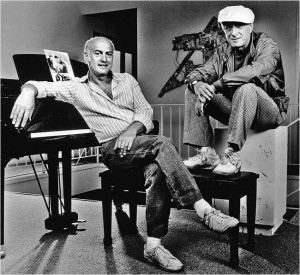 |
Jerry L: It was originally written as a send-up of country music, but Elvis sang it from the heart and it became a true love song.
Mike S: Elvis' version of "Love Me" became a big hit and a standard. He managed to transform this simple tune into something genuinely touching.
Jerry L: For Elvis' movies, for instance, they'd send us a script and there would be indications of where the screenwriter or director thought a song should appear. Our job was to come up with the songs, and ultimately we decided where they would go.
Mike S: We submitted the songs through the appropriate channels, which meant Freddy Bienstock, who worked for his cousins, the Aberbachs. That was the system that had been established by Colonel Parker. No one was to approach Elvis directly without the Colonel's sanction. We wrote "Jailhouse Rock" for the film. Jerry and I came to New York for about three weeks in March of '57. We were seriously considering the possibility of moving there. We took a suite at the Gorham Hotel on 55th Street and had a rented upright piano put in the living room, where I spent next to no time at all. One day Jean Aberbach gave us an assignment to write the score for the forthcoming Presley movie. We were so excited at being in Manhattan with all the Broadway shows and jazz clubs that we kept putting off the job.
On a Saturday morning there was a knock at our door and Jean Aberbach walked in. "Well boys, where are my songs?," he said. "Don't worry, you're gonna get them,"' we assured him. I know," he said, "because you're not going to leave this room until I have them." Then lie pushed a sofa in front of the door—our only way out. "I'm going to take a nap," he explained. He literally went to sleep and we couldn't get out. So, out of necessity, we wrote four songs in about four or five hours:
"Jailhouse Rock," "Treat Me Nice," "(You're So Square) Baby I Don't Care" and
"I Want To Be Free."
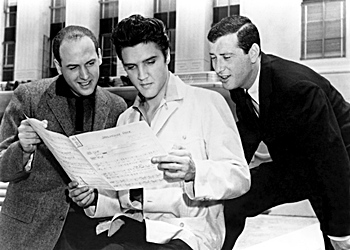
| (Right: Elvis checks out Jailhouse Rock with Mike Stoller & Jerry Lieber) Jerry L: We were the producers without portfolio. flat was a given. Steve Sholes was a great guy, big, heavy set and very good natured. He came up to me and said, "Hey, Jer, you guys know more about this rock and roll stuff than I do. Why don't you just take over?" And we did. We didn't get credit and we didn't get paid but we got a hit score and some hit records.
Mike S: Elvis requested that we be at the "Jailhouse Rock" recording sessions. The studio was like a living room. He had all his pals there with him. We'd demonstrate the songs for him. It was long hours and hard work in the studio but Elvis made it seem effortless. He could sing take after take and never get tired. He was unreal.
|  |
On the last day of recording, the casting director said to Jerry, "You should come over to MGM tomorrow and play the part of the piano player in the film. "But I'm not a piano player," Jerry said. "That's all right," the casting director said, "you look like one".
(Right:Jailhouse Rock - Mike Stoller is the piano player far right. The role had in fact been given to Jerry Lieber) Jerry L: I was supposed to show up the next day for shooting, I had this problem with a wisdom tooth and my face was twice as big as normal. So, I called Mike and told him to get over to MGM and do the job. Mike said, "But they're expecting you." I told him, "They won't know the difference." When he showed up, all they said to him was, "You better shave your beard off. It's a scene stealer."
Mike S: That's how I became a famous movie star.
Jerry L: Elvis got to a point where he became very superstitious, and would not set foot in a recording studio without us. Of course, we were very flattered. | 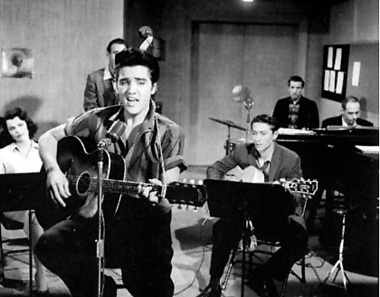 |
Mike S: In the beginning we were kind of curious about this guy who was such a big hit—a white guy singing R&B. We would talk about different kinds of blues records and he knew a lot about the blues. He constantly surprised us. He knew all of our stuff. And, of course, he knew all the country and gospel songs.
One Friday afternoon at MGM Elvis said to me,
"Mike, I'd like for you and Jerry to write me a real pretty ballad." Jerry and I got together Saturday morning any, by the end of the day we had finished
"Don't." On Sunday we booked a studio to cut a demo and called Young Jessie to sing the song. I gave the demo to Elvis on Monday and he loved it. Then came a big to-do with Colonel Parker because I hadn't gone through the appropriate channels. You see, when Elvis loved a song, he wanted to record it. Tom Parker and the Aberbachs greatest fear was that Elvis might insist on recording song that their publishing company didn't own.
King Creole was possibly the best movie that Elvis ever made. It had the best story, the best script, and great cast. Michael Curtin, the director, was at all the recording sessions. We wrote three songs for that film including the title song.
Jerry L: I especially liked
"Trouble" and I loved the way he it in the comeback special. He brought a menace to that song. I mean if you're for trouble, you're gonna get your brains knocked out. That kind of menacing thing was natural for him He had different degrees, different variations and different permutations of potential danger. Just the LOOK on his face from time to time was WATCH OUT! I think the little girls really loved that.
Jerry L: In between Jailhouse Rock and King Creole, Elvis was back at Radio Recorders finishing a Christmas album. They were shy one song. Colonel Parker entered the control booth and said, "Hey boys, can you write me one more tune?" I said, "When do you need it?" He said, "Now." We went into the Men's room and wrote
"Santa Claus Is Back In Town" in about five minutes. Mike walked out of the Men's room first. As he opened the door to the control booth I heard Parker say, "What took you so long?"
One evening in New York I was invited to a very elegant New York cocktail party at the home of Charles Feldman, the well-known agent and producer. He said, "I'm so pleased to meet you. I think the world of the work that you and your partner have done. I have just optioned a novel by Nelson Algren,
A Walk On The Wild Side, and here's what I want to do. Elia Kazan has agreed to direct it and I've got Bud Schulberg to write the screenplay and James Wong Howe to do the cinematography. I want you and your partner to write the songs and Elvis Presley to play the lead." I was ecstatic. I called Mike and he was thrilled. We thought the news was going to blow the minds of Elvis and the Colonel and Jean and Julian Aberbach. We went up to the Aberbachs office at Hill & Range, and I told them the whole story, including every exciting detail.
When I was finished, Jean said, "We'll have to speak to Colonel Parker. Can you boys wait outside?" As we sat outside Jean's office we imagined how excited Parker would be. After ten minutes or so we were summoned back into Jean's office and he reported to us that
The Colonel said, "If you ever dare try and interfere in the career of Elvis Presley again you will never work in New York, Hollywood, London or anywhere else in the world." Mike S: That was it. After that we stopped writing for Elvis. He continued to record songs of ours that had already been recorded by other performers. There was one exception—Doc Pomus called us up one day. We were all in the Brill Building. Doc was a dear friend and Jerry and I had produced lots of Doc and Morty's (Shuman) songs with the Drifters. Mort had either- gone off to Japan or moved to Paris. Doc, who was feeling somewhat abandoned, said, "Come on up, let's write a song for Elvis." So, at Doc's request, the three of us did just that. The song was
"She's Not You."
Jerry L: Elvis did a really good job on it. He never did a bad job on any song. "She's Not You" is based on the style and sentiment of "I Really Don't Want To Know," one of the greatest country songs ever written.
"Just Tell Her Jim Said Hello" was actually written with Johnny Cash in mind, but we sent it to Freddy Bienstock as a submission for Elvis.
Jerry L: The kind of humor we used in the songs for the Coasters was like a modern day version of burlesque or vaudeville. A lot of that stuff was inspired by radio programs that I used to listen to as a kid. I turned some stuff into three-minute comedic operettas for them. We wrote things like "Little Egypt," "Yakety Yak," "Charlie Brown" and "Along Came Jones" in that vein. Funny songs. After we broke with Parker and the Aberbachs, we were told that Elvis was gonna do this spectacular on TV and to take a look.
There was a production number on
"Little Egypt" and
"Girls! Girls! Girls!" It was the best show I'd ever seen. We hadn't suggested to Elvis that he do those songs of ours. He picked them himself. On "Little Egypt" he had a glint of humor, but mainly it was sexy. Even when he was singing a heartfelt ballad there was some kind of undertone of sexuality.
Mike S: I think Elvis' performance of the songs we wrote for him were generally better than those that were written for someone else. "Love Me" is an exception. It was a great performance.
Jerry L: Elvis did a good rendition of "Bossa Nova Baby." I liked it a lot. It was right. It was 'spot on' as they say in Liverpool.
The original version of "Fools Fall In Love" was by the Drifters. It featured a very high type of lead vocal a la Clyde McPhatter.
Mike S: I thought Elvis' recording was in too high a key. Maybe he learned it from the Drifters' record and wanted to do it the same key. He did have an enormous range.
Years later when he was working with Chips Moman, we were told that they had actually cut a track "Kansas City" but the voice was never recorded. would have loved to have heard Elvis sing it.
|  |
Jerry L: I got walking pneumonia sometime in the Sixties. I collapsed in the (Greenwich) Village and went to the hospital. I was on the critical list. I was there for ten or 12 days. I finally got better and was discharged. I got home and saw 20 or more pieces of mail, a lot of them manila envelopes, as well as some telegrams. The telegrams all said, "Elvis is getting ready to record. Please come to California immediately. He doesn't want to set foot in a studio without you.
I called and asked to speak to (Colonel) Tom. He got on the phone and said (Leiber imitates Parker) "How you doin' boy?" I said, "I'm OK. I had a real close call there. I had walking pneumonia and I just got out of the hospital." He said he wanted me to pack right away and catch a plane. I told him I wasn't in any shape to catch a plane because I'd just gotten out of the hospital. He said, "If they let you out, that means you're all right." I told him I needed a day or two to get myself together, but he said the schedule was very tight and he needed me to come out right away.
Then he said, "Did you see the contract yet?" I said, contract?" He said, "I'm sure it's there by now. It's a contract covering the forthcoming movie and soundtrack album. You better take a look, sign it and send it back. So I hung up, took the contract out of one of the manila envelopes, and saw nothing but a blank page. Nothing was written on it except two lines at the bottom where Mike and I were supposed to sign our names.
I thought they had made a ridiculous blunder. I called Parker's secretary and said, "There's been a mistake", she said, "Let me get Tom." Colonel Parker got on the phone and I told him, "There's a piece of paper here with two places for signatures, but the contract is missing." He said, "There's no mistake - just sign it." Then he said, "Don't worry. We'll fill it in later."
I got off the phone with Parker and immediately called Mike. I told him, "Breaking up with the Presley outfit is like throwing away a license to print money. After all this work, I really hate to do it, but I am really offended" (When I was on the phone with Parker, I almost told him that I wasn't one of his 'okie dokies'). I told Mike I didn't want to work with this jerk anymore.
I asked Mike, "How do you feel about this?" Now Mike is a very measured and modest with very good manners. He paused for a moment, and then he said, Jer ....tell him to fuck himself!"
So I called Colonel Parker back and said, "Tom, I thought about what you told me." He said, "Good! What time are you gonna get here?" I said, "Tom, I spoke to Mike about the contract, and he told me to tell you to go fuck yourself."
I hung up, and I never spoke to him again.
(Go here to our detailed article on "The Dark Side Of Colonel Parker")
Jerry L: Many years went by. One day I walked into my office on 49th and Broadway. I went up to the 11th floor and my secretary says, "Hey Jer, you got a note that's probably worth a million dollars if you sell it at Sotheby's." I said, "What's that?" She said, "It's a note from E.P." I said, "You're kidding? What does it say?"
It said, "Dear Jer, I'm leaving four tickets for tomorrow night's show at the (Madison Square) Garden and I want you to bring your family and see my show." One of the reasons I never saw my acts in person over all those years was that I was claustrophobic and I couldn't take the crowds. But I went and took my family. "I'm gonna grit my teeth," I thought, "I'm gonna grin and bear it and go to the show. It's Elvis!" I loved the guy and hadn't seen him in a coon's age. We went to Madison Square Garden and we were in this select elegant box seat with a great view of the great E.P. We sat there and watched the show and he's overweight but he looked magnificent to me. He was great and I enjoyed every minute of it. One, it was Elvis Presley. Two, he sang a couple of our songs. Three, I'd NEVER been to a live concert of ANYONE I've ever produced or wrote for. It was incredible. It was like going to see Joe Louis knock out Max Schmeling.
|  |
At the end when the orchestra starts playing his finale theme, I looked around and said, "Get out of here now, it's gonna be a stampede" and we left. When I got to the office the next day my secretary hands me a note and says, "Read this." It says,
"Why did you leave." It was from Elvis. He wanted to know why I left early.
There were over 20,000 people in the audience and he saw me leave. How 'bout that?
________________________________________________________________________
Make sure you get a copy of 'Writing For The King' for the full, unedited interview with many more stories told by Mike Stoller about their times together.
Interview by Ken Sharp - EIN presentation & Edit by Piers Beagley.
--Copyright EIN August 2011
EIN Website content © Copyright the Elvis Information Network. Reprinted with permission. DO NOT COPY without authorisation.
Click to comment on this interview.
'ELVIS Vegas '69' by Ken Sharp - also tells the remarkable story of Elvis' return to the concert stage told through first-hand accounts by those lucky enough to be on hand to witness Elvis' miraculous artistic and creative rebirth.
At only US$58 including P&P in the US. CLICK HERE for 'ELVIS Vegas '69' special purchase details
Go here for EIN review of KEN SHARP's fascinating book 'Writing For The King'
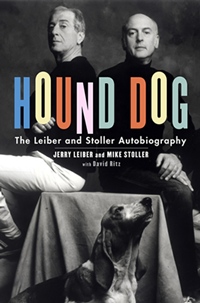
'Hound Dog' Leiber & Stoller autobiography: 'Hound Dog: The Leiber & Stoller Autobiography' by Jerry Leiber, Mike Stoller with David Ritzs was released in June 2009. The publicity notes, "In 1950 a couple of rhythm and blues-loving teenagers named Jerry Leiber and Mike Stoller met for the first time. In 1956 "Hound Dog" would become a #1 record for Elvis Presley, and Jerry and Mike became the King's favorite songwriters. They wrote such early Elvis hits as "Jailhouse Rock," "Treat Me Nice," and "You're So Square (Baby I Don't Care)." Their affection for Elvis was mutual, but Elvis's manager, "Colonel" Tom Parker, didn't appreciate Jerry and Mike's independent ways and ended the relationship." Hardcover: 336 pages, Publisher: Simon & Schuster (June 9, 2009). ISBN-13: 978-1416559382. In a recent press interview they talked about their times writing in the fifties and working with Elvis. Mike Stoller: I always thought of it as R&B, but when people told us it was rock'n'roll I took their word for it. But rock'n'roll -for a lot of people it was everything they loved and for other people it was everything they hated. Jerry Leiber: We were really committed to black music, not rock'n'roll. We thought rock'n'roll was really silly, to be frank with you and concocted by Alan Freed and Jerry Wexler and a couple of other ne'er-do-wells in the music business that were trying to rustle up publicity and excitement about a form, and the form was essentially white." Go here for the interview highlights. (News, Source;EIN) |  |
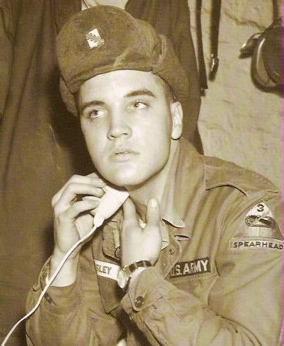 Actually, the military was making a special case of Elvis by isolating him from the press. Guild pointed out that when journalists from back home arrived in Germany looking for a story, local military officials would usually make some hometown soldiers available for interviews. "But if photogs or reporters from New York, Hollywood or Memphis arrive, they're absolutely barred from contacting Elvis during duty," Guild explained. "And the Armored Div hasn't taken a single photo of him at work."